
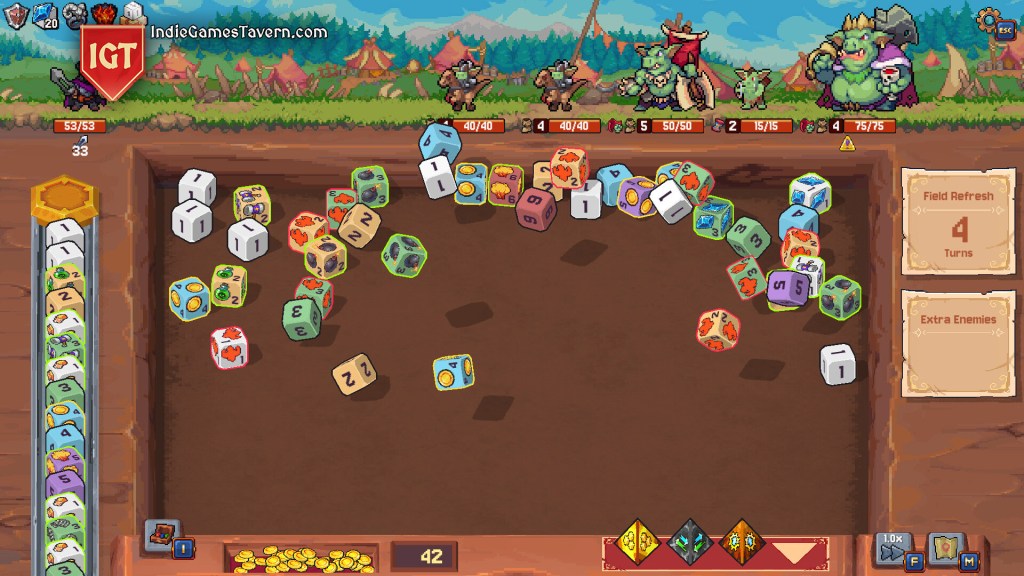
Rune Dice is an indie roguelike / deck-building / dice-throwing hybrid from developer Smart Raven Studio, published by Kwalee. The game’s demo is currently available on Steam.
The core hook of Rune Dice: instead of traditional cards or chips, you “throw” dice — dice merge when matching values, triggering magical chain reactions that deal damage or create effects. On top of that, you build synergies between dice, relics, and runes; choose a hero class; and fight waves of enemies and bosses.
If you enjoy deck-builders, roguelikes, and physics-based randomness — the game offers a distinctive twist combining strategy, luck, and spectacle.
Let’s follow us at Indie Games Tavern to dive in this indie game review, now!
Gameplay & Core Loop
- Dice-Throwing + Physics + Merges: At each combat encounter, you “launch dice” onto a battlefield. Matching dice (same value) fuse into a stronger die; that release of energy causes chain reactions, which can damage enemies, apply status effects, or trigger spells.
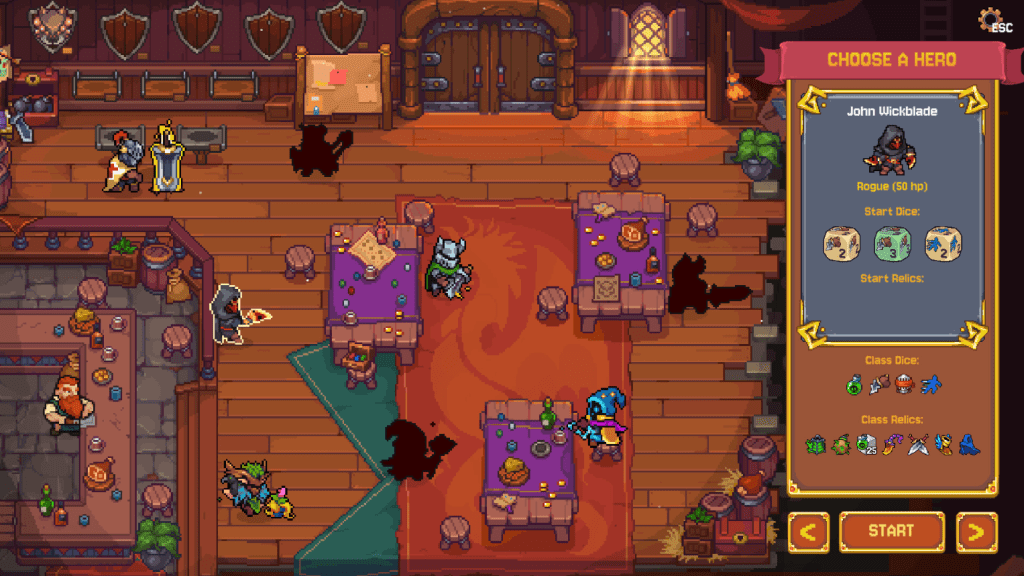
- Hero Classes & Abilities: Rune Dice has (in demo) multiple hero classes — each with unique dice types and magical abilities. Classes include Mage, Rogue, Warrior, etc., offering different tactical approaches (e.g. poison, freeze, heavy-damage, etc.) depending on your dice + class synergy.
- Deck / Build Customization: Between fights you can collect new dice, find relics, gain runes — each affecting how dice behave (special powers), or giving passive bonuses. Over time, this allows customizing your build/style: aggressive chain-combos, status-effect builds, defensive builds, etc.
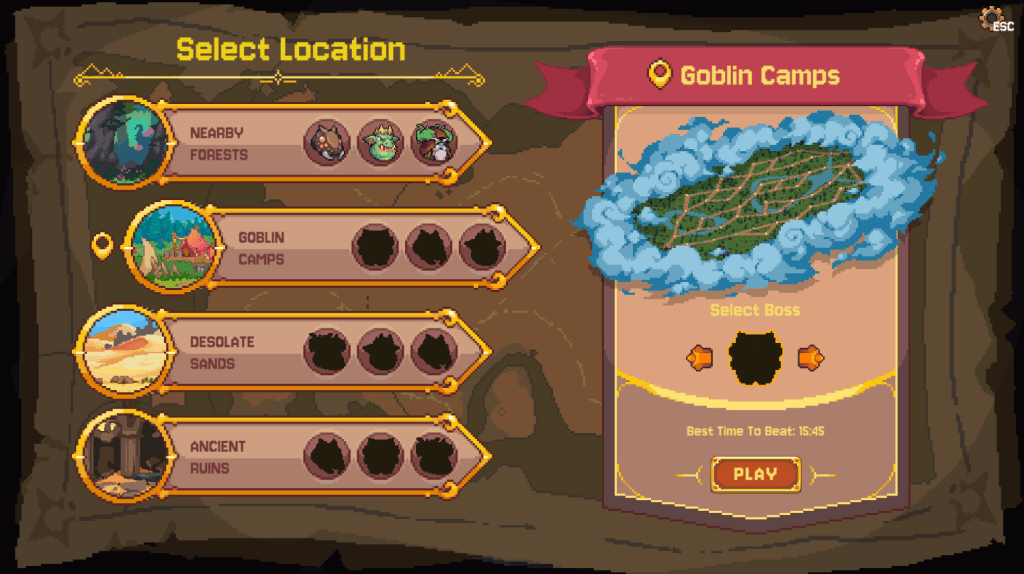
- Procedural Encounters & Boss Fights: Runs consist of procedurally generated maps/encounters leading up to bosses or mini-bosses. Bosses can dramatically change the “dice field” or enemy behavior — forcing you to adapt strategy rather than rely on a single build.
- Roguelike Progression: Like many roguelike-deckbuilders, failure is possible — but each run rewards you with relics/dice/unlocks that improve future runs. So even unsuccessful runs feel like progress, encouraging repeated playthroughs.
Let us Indie Games Tavern make it short: roll dice → attempt merges → unleash chain reactions / spells → defeat enemies → collect loot (dice/relics/runes) → upgrade build → repeat. Over successive runs, build depth accumulates, enabling more complex strategies.
What Works Really Well
✅ Fresh Spin on Deckbuilding / Roguelike Genres
Turning cards/spells into physical dice you throw — with physics-driven merging — gives a tactile, satisfying feel. The randomness of dice + the planning of strategy balance luck and skill in a novel way. This kind of hybrid design feels rare and creative; Rune Dice avoids feeling like “just another deckbuilder”, and this is why we decided to write this indie game review.
✅ Replayability & Build Diversity
With multiple hero classes, many dice types, relics, runes — the build variety is large. You can experiment with different combinations: say, a poison-effect dice build vs. a freeze-oriented mage vs. heavy damage warrior. This means many runs will feel different, and there’s room to discover creative, fun synergies.
✅ Bite-Sized Sessions; Accessible Entry Point
Because each run (or encounter) is relatively compact, the game suits short play sessions. That’s good for players who don’t have long free time. The demo is free, so you can test the core mechanics without commitment.
✅ Indie Charm & Transparent Development
As an indie game, Rune Dice shows ambitious, experimental design. Developers appear open to feedback (playtests, community input) which often bodes well for ongoing polish and content additions. We Indie Games Tavern always highly appreciate the indie gamedev who puts attention and gives effort on building the fan base for their game, beside focusing on polishing the game.
✅ Strategic Depth — Luck + Skill Blend
Because dice mechanics layer randomness on top of strategic decisions (which dice to throw, when to merge, what relics/runes to pick), a good player can mitigate randomness. Skill still matters — well-timed throws and resource management can overcome bad luck, making wins feel earned and satisfying.

Areas for Improvement & Considerations
⚠️ Early / Demo State – Limited Content
As of now, only the demo is released. While core mechanics are present, the full game (scheduled release 2026) isn’t out yet. So overall depth, end-game content, and long-term balance remain unknown.
⚠️ Randomness & Luck Can Be Frustrating
Because dice are physical/physics-based, outcomes can sometimes feel unpredictable: a mis-aimed throw, a bad bounce, or unlucky roll can ruin a run — even if your strategy was solid. For players sensitive to randomness, this can feel unfair.
⚠️ Balance & Build Volatility
With so many variables (hero class, dice types, relics, runes), balancing may be tricky. Some builds might overshadow others, or certain dice types may become “must-haves,” reducing build diversity over time. Until full release, it’s hard to know how well devs will tune that.
⚠️ Potential Repetitiveness Over Long Runs
Given the roguelike loop and reuse of dice + relic/rune pools, after many runs the game may begin to feel familiar or predictable — especially if the variety of dice/relics is limited or pool stagnates.
⚠️ Visual / Mechanical Clarity During Chaos
With many dice bouncing, merging, triggering chain reactions, relic/rune effects, and enemies, the screen could get chaotic. This might make it hard to read what’s happening or plan precisely, especially during late-game crowd fights. As some early community feedback suggests: “upper screen playing area vs dice field area” separation can feel disconnected.
Final Thoughts
To us at Indie Games Tavern, Rune Dice is a promising and inventive take on roguelike-deckbuilding. Its blend of dice-physics, merge-reaction mechanics, class variety, and build-customization delivers a fun recipe that mixes randomness and strategy in a satisfying way. For players who like experimenting, adapting, and letting chance mingle with tactics — Rune Dice’s demo shows a lot of promise.
That said — it remains early. As with many indie games in development, a lot depends on how well the full version balances randomness, content variety, and long-term progression. If you enjoy trying new builds, don’t mind unpredicatability, and enjoy dice-based randomness, it’s worth giving a shot now (demo is free). If you prefer highly predictable, polished, balanced games — maybe wait until full release.
Wrapping up this indie game review, Rune Dice is among the most creative indie roguelike-deckbuilders lately — and one worth keeping an eye on.
Who Should Play It?
- Fans of roguelike + deck-building + randomness + physics-based mechanics.
- Players who enjoy short, replayable sessions rather than long, committed campaigns.
- Tacticians who like to experiment with builds, dice, relics, runes — mixing and matching to create synergies.
- People who appreciate indie games with ambition and experimental design.
- Those who don’t mind luck + skill interplay — ready to adapt when randomness throws curveballs.
Who Might Wait or Skip It?
- Players who dislike randomness or physics-based chaos in gameplay — may find dice-based outcomes frustrating.
- People seeking deep narrative, long campaigns, or story-driven RPGs — Rune Dice focuses on mechanics and replay loops, not story.
- Those expecting fully polished, AAA-level production — as an indie game with demo status, polish and content depth remain uncertain.
- Gamers who prefer pure skill-based games, where outcomes feel more under their control — dice mechanics inherently limit that.
- Players who dislike grinding / repeated runs — the game’s loop depends on replaying runs, experimenting builds, and incremental progress.
Rune Dice Review by Indie Games Tavern.
Your cozy corner of indie gems. We’re more than just a indie game review channel, we’re a sanctuary for the unsung heroes of indie gamedev. Born from a love of the underdog, the quirky, and the downright brilliant, the Indie Games Tavern is your trusty guildhall for discovering the finest indie games—those hidden gems, wild experiments, and heartfelt labors that big studios often overlook. Picture this: a weathered oak table laden with scrolls—each a indie game review penned by your tavern scribes, folks like me who’ve braved the pixelated wilds to bring you tales of triumph, terror, and everything in between.
 Indie Games Tavern
Leave a comment