
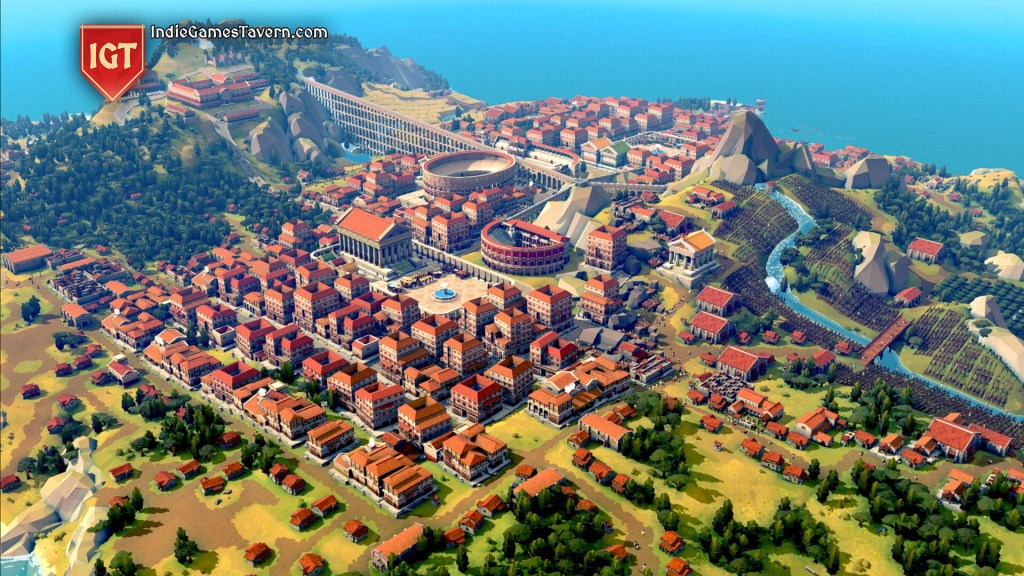
Nova Roma is an upcoming city-building / simulation strategy game from indie developer Lion Shield (the studio behind Kingdoms & Castles), set in a post-decline Roman-Empire era. You lead a small band of citizens seeking to found a new Rome — building towns, managing resources, appeasing the gods, and tackling logistics and social needs as you grow from a humble village into a metropolis.
As of December 5, 2025, a free demo of Nova Roma is available on Steam — a taste of its core city-building, water-management, and civic planning systems. The full Early Access release is planned for January 22, 2026.
Let’s follow us at Indie Games Tavern to dive in this indie game review, now!
Gameplay & Core Loop
- Founding a “New Rome”: You start with a small group of settlers aiming to revive Roman ideals. You must build housing, infrastructure, manage resources, and cater to your population’s evolving needs.
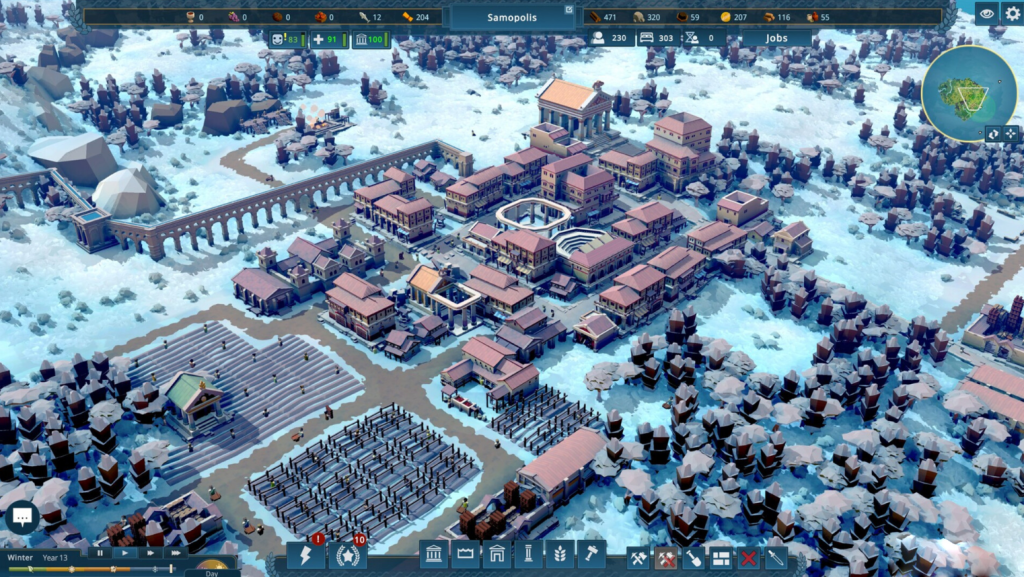
- Complex Water & Terrain Systems: A standout feature — the game includes realistic water simulation. You’ll build aqueducts, dams, reservoirs and manage watersheds to irrigate land, supply water, and prevent floods. Water flow affects soil fertility, shaping which lands are viable for farming or expansion.
- Supply Chains & Resource Management: As your city grows, you must establish supply lines for raw materials and processed goods, plan transport routes across sometimes difficult terrain, and ensure logistics keep up with demand — a proper logistical challenge beyond simple “build-and-watch”.
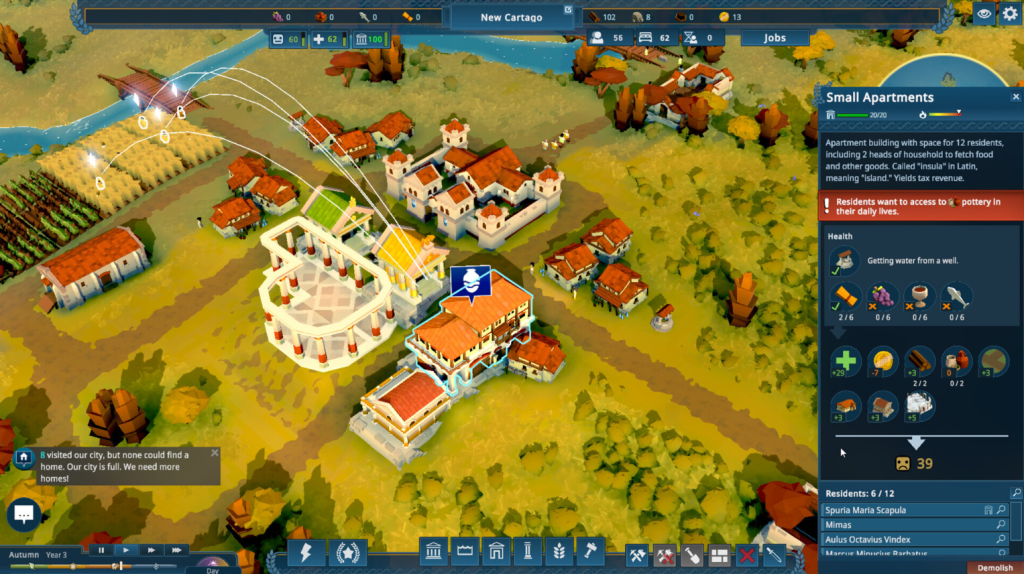
- Citizen Needs & Social Infrastructure: Citizens have varied needs: food (bread, wine), goods (pottery, tools), entertainment (games, gladiator events, theater), and social services. As your settlement evolves, you must balance work, welfare, happiness — or risk dissent.
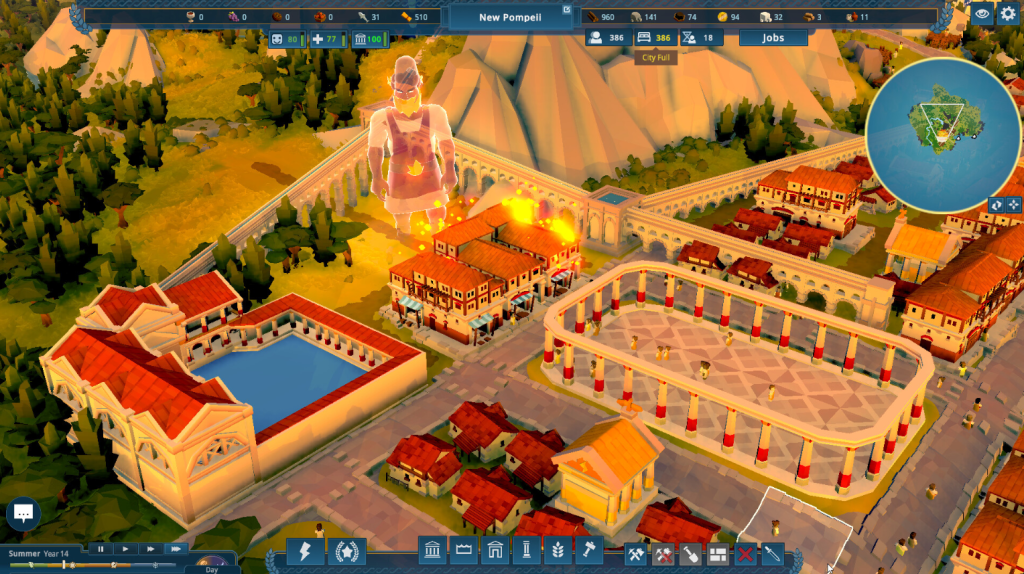
- Divine Favor & Religion: Religion plays a role — you can build temples, appease the gods, and use divine favor to unlock technologies or protections. Neglect or arrogance may bring the gods’ wrath (floods, famine, misfortune) — adding an extra layer of challenge and flavor.
- Urban Planning & Civilization-Growth: As the city evolves, you manage urban sprawl, infrastructure, tax and law (through edicts), and social stratification (artisans, gladiators, laborers, etc.). The goal: not just a functioning city, but a thriving, culturally rich “New Rome”.
Let us at Indie Games Tavern make it short: settle → plan water / terrain → build infrastructure → manage resources & population → satisfy needs & social demands → expand / diversify → deal with disasters / divine demands → repeat at larger scale.
What Works Really Well
✅ Deep Simulation & Systems — Water, Terrain, Logistics
Nova Roma distinguishes itself with its water-simulation and terrain mechanics. Building aqueducts or dams isn’t cosmetic — it meaningfully shapes land fertility, city layout, and survival viability. That kind of environmental realism gives the city-builder depth and makes planning feel thoughtful and consequential.
✅ Rich Blend of City-Building, Resource Management, and “Civilization as Society”
It’s not just about houses and roads — Nova Roma requires you to consider citizens’ goods, entertainment, social classes, culture, religion, and even politics (taxes, edicts). That breadth of simulation appeals to players who like micro and macro-management, long-term growth, and complexity beyond simple build-and-expand.
✅ Theme & Setting: Rebirth of Rome, Mixed With Challenge
The setting — a Rome in decline, being rebuilt from scratch — gives strong narrative flavor and motivation. The idea of founding a “New Rome”, blending classical themes with city-builder simulation, is compelling. Water systems, gods, citizens, infrastructure issues — it feels like a living world, not just a sandbox.
✅ Early Demo Shows Promise + Positive Early Feedback
The demo already appears to resonate with players: as of early December 2025, it has a “Positive” user-review rating on Steam. Early coverage from outlets praises its ambition and mechanics, indicating this could be one of the most interesting city-builders of recent years.
✅ Manageable Requirements, Accessible for Many PCs
The stated minimum specs are quite reasonable (modest CPU/GPU requirements), making Nova Roma accessible to many players even if they don’t have high–end PCs.
Areas for Improvement & Considerations
⚠️ Still Early — Many Systems Likely Need Polishing
Nova Roma is not yet fully released (early access planned for Jan 2026). As with any intricate city-builder early in development, there’s risk: water simulation bugs, balancing issues, UI/data-management complexity, or poorly tuned resource/need curves could impact long-term stability.
⚠️ Complexity Can Be Overwhelming for Casual Players
Given the number of overlapping systems (water, terrain, resources, citizen needs, divine favor, logistics, social strata), players new to simulation games may find it daunting. Without careful planning, mistakes can cascade (floods, starvation, civil unrest).
⚠️ Replayability & Long-Term Goals Still Unclear
Because the demo and early early-access phase are limited, it remains to be seen how deep late-game content, expansion mechanics, or long-term goals are. For example: how varied will disasters, politics, or external threats (barbarians, empire, nature) be?
⚠️ Balance Between Fun vs Micro-Management
For players who like relaxed city-builders (cozy, slow, minimal micromanagement), Nova Roma’s demands (logistics, supply chains, water, fertility) might feel more like work than fun. The simulation-heavy side can become a grind if not balanced by engaging events or emergent narrative.
⚠️ Potential for Performance Issues in Large Cities
With detailed water simulation, terrain manipulation, and large maps, as city grows complexity, performance may suffer especially on older or modest hardware. The demo’s requirement list is modest — but real-world performance under load may vary.
Final Thoughts
Nova Roma is shaping up to be a deep, ambitious, and thematically rich city-builder — one that goes beyond “build houses, watch citizens prosper” to simulate water, terrain, logistics, society, religion, and the fragile balance between growth and sustainability.
To us at Indie Games Tavern, if the developers deliver on the features in demo + promises (water & terrain simulation, social complexity, resource chains, divine/intervention systems), Nova Roma could become one of the most compelling city-building games of 2026 — especially for players who like simulation depth, long-term planning, and immersive historical-fantasy settings.
That said — it’s still early. If you prefer polished, stable games with years of content or prefer simpler, more relaxed builders — you might want to wait until full launch and user feedback before diving in.
Who Should Play It?
- 🏛️ Fans of city-builders with depth, simulation, and classical/Roman aesthetics — if you enjoy planning societies, managing resources, and building complex supply chains.
- 📊 Players who like logistics, resource-management, and long-term planning — water, terrain, supply networks, social needs, and risk management are at the core.
- 🎯 Strategy and simulation enthusiasts who enjoy layered mechanics: terrain geography, water physics, citizen needs, growth, and environmental consequences.
- ⚙️ People who like “sandbox with challenge” — not just cozy city-building but realistic constraints, tradeoffs, and consequences for mismanagement.
- 💡 Those open to early-access / in-development games — who don’t mind rough edges and want to see a game evolve over time.
Who Might Wait or Skip It?
- 💤 Players wanting casual or relaxing gameplay — if you dislike micromanagement, complex systems, or risk of cascading failures.
- 🎮 Fans expecting heavy action, combat, or scripted stories — Nova Roma is about planning, building, and management rather than combat or RPG-style adventure.
- 📉 Those who dislike simulation-heavy games — if resource/needs simulation feels like work rather than fun, this might not appeal.
- 🛑 Players who dislike early-access instability or incompleteness — waiting for full reviews might be wise.
Nova Roma Review by Indie Games Tavern.
Your cozy corner of indie gems. We’re more than just a indie game review channel, we’re a sanctuary for the unsung heroes of indie gamedev. Born from a love of the underdog, the quirky, and the downright brilliant, the Indie Games Tavern is your trusty guildhall for discovering the finest indie games—those hidden gems, wild experiments, and heartfelt labors that big studios often overlook. Picture this: a weathered oak table laden with scrolls—each a indie game review penned by your tavern scribes, folks like me who’ve braved the pixelated wilds to bring you tales of triumph, terror, and everything in between.
 Indie Games Tavern
Leave a comment